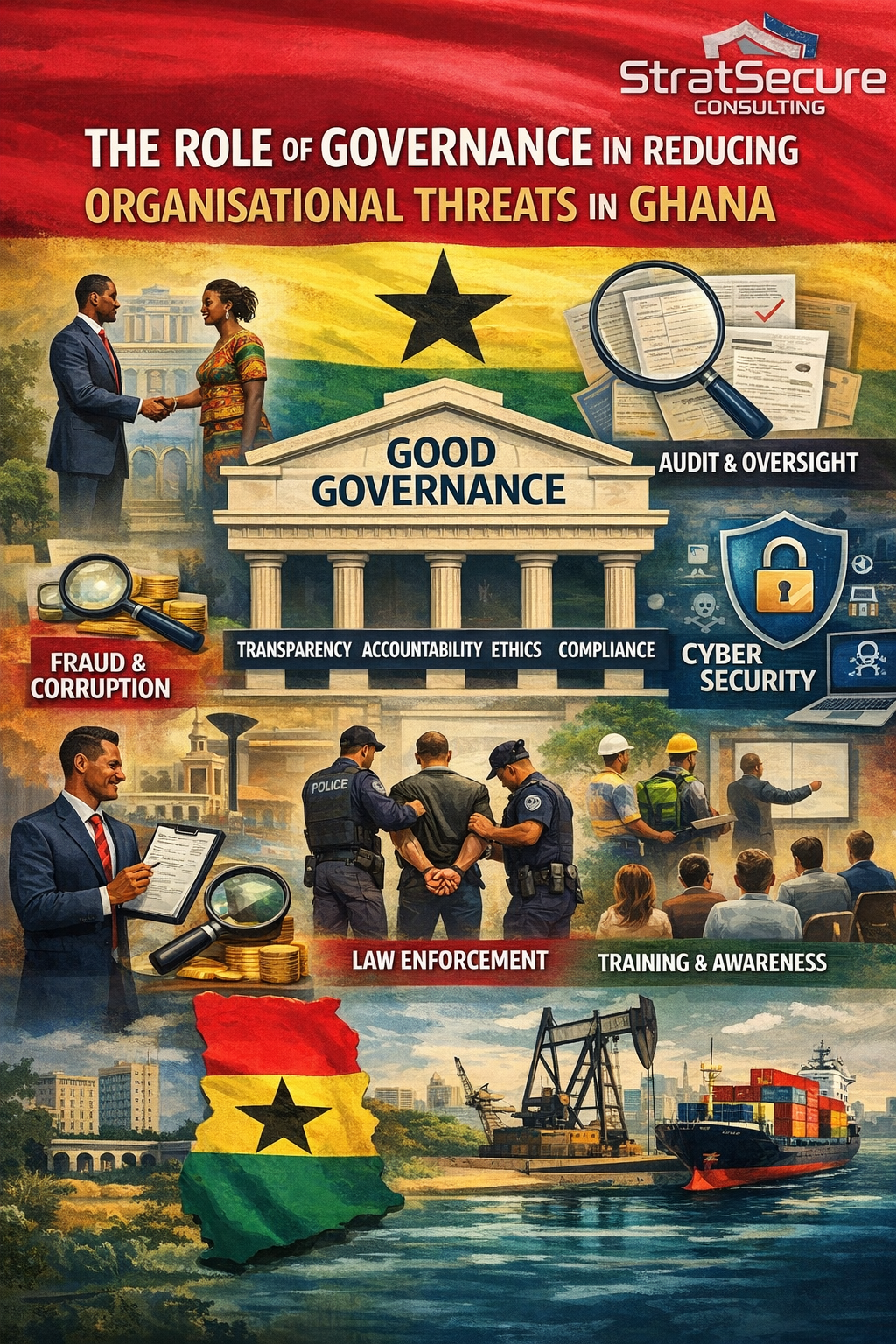
The Role of Governance in Reducing Organizational Threats in Ghana
Expert Commentary & Opinion Policy & public Interest CommentaryPosted by admin on 2026-03-03 21:45:21 |
Share: Facebook | Twitter | Whatsapp | Linkedin Visits: 556
The
Role of Governance in Reducing Organizational Threats in Ghana
By
Kelvin Amegbor
In
Ghana’s evolving economic and security landscape, organizational threats are no
longer limited to physical theft or occasional fraud. Today, institutions face
a complex mix of risks that include cyber intrusion, insider misconduct,
regulatory non-compliance, reputational damage, operational disruption, and
crisis mismanagement. While many organizations respond by investing in guards,
technology, or compliance checklists, the most decisive factor in reducing
these threats is often overlooked, governance. Strong governance is not merely
an administrative requirement, it is the foundation upon which effective
security, resilience, and trust are built.
Governance
defines how decisions are made, who is accountable, and how risks are
identified, prioritized, and managed. In Ghana, where organizations operate
within dynamic political, social, and economic environments, weak governance
structures frequently amplify threats rather than contain them. When leadership
oversight is unclear, policies are poorly enforced, and risk management is
fragmented, even well-funded security measures fail to deliver meaningful
protection. Conversely, organizations with strong governance frameworks are
better positioned to anticipate threats, respond decisively to incidents, and
sustain operations during crises.
One
of the most significant ways governance reduces organizational threats is
through clarity of responsibility. In many Ghanaian institutions, security and
risk management are treated as operational afterthoughts, delegated to junior
staff without authority or excluded from strategic decision-making. This
disconnect creates gaps where threats flourish unnoticed. Effective governance ensures
that security, risk, and resilience are embedded at the executive level, with
clear reporting lines and decision rights. When boards and senior management
actively own risk oversight, threats are no longer abstract concerns but
strategic issues requiring deliberate action.
Governance
also plays a critical role in shifting organizations from reactive to proactive
threat management. Without structured governance, responses to incidents are
often improvised, inconsistent, and driven by urgency rather than analysis.
This approach leads to repeated losses, unmanaged vulnerabilities, and
escalating costs. Strong governance mandates systematic risk assessments,
regular reviews, and evidence-based decision-making. It compels organizations
to ask not only what went wrong, but why it went wrong and how similar threats
can be prevented. In doing so, governance transforms security from a cost
center into a strategic investment.
In
the Ghanaian context, insider threats remain one of the most damaging and
underestimated risks. Fraud, data leaks, sabotage, and collusion frequently
involve trusted employees or contractors exploiting weak oversight. Governance
reduces insider threats by establishing robust policies, ethical standards, and
accountability mechanisms that guide behavior across the organization. When
recruitment, access control, performance management, and disciplinary processes
are governed by clear rules and enforced consistently, opportunities for abuse
are significantly reduced. Equally important, strong governance fosters a
culture where employees understand that integrity and security are shared
responsibilities, not optional values.
Another
critical dimension is regulatory and legal exposure. Ghana’s regulatory
environment continues to evolve across sectors such as finance,
telecommunications, energy, and data protection. Organizations with weak
governance often struggle to keep pace, exposing themselves to sanctions,
litigation, and reputational harm. Governance frameworks that integrate
compliance into enterprise risk management enable organizations to anticipate
regulatory changes, align internal controls, and demonstrate due diligence.
This not only reduces legal threats but also strengthens stakeholder confidence
among regulators, investors, customers, and partners.
Crisis
management further illustrates the power of governance in threat reduction.
Emergencies, whether caused by fires, cyberattacks, civil unrest, or system
failures, test the true resilience of an organization. In Ghana, many institutions
lack tested emergency response and business continuity plans, leading to panic,
confusion, and prolonged downtime when incidents occur. Governance ensures that
crisis preparedness is not left to chance. It defines who leads during
emergencies, how decisions are escalated, and how communication is managed
internally and externally. Organizations with strong governance recover faster,
protect their people more effectively, and preserve their reputations under
pressure.
Governance
also enables better integration of physical, cyber, and operational security.
As digital systems increasingly control physical processes, the separation
between IT risk and physical security becomes a serious vulnerability. Weak
governance allows silos to persist, leaving gaps that sophisticated threats can
exploit. Effective governance breaks down these silos by aligning departments
under a unified risk framework. It encourages collaboration, shared
intelligence, and coordinated controls, ensuring that security measures
reinforce rather than undermine one another.
Importantly,
governance is not about bureaucracy or excessive control. Poorly designed
governance can indeed stifle initiative and slow decision-making. However,
effective governance is enabling rather than restrictive. It provides clarity,
consistency, and confidence, allowing organizations to operate decisively
within defined risk tolerances. In Ghana’s competitive business environment,
this clarity becomes a strategic advantage. Organizations with strong
governance are better equipped to pursue growth opportunities, manage
partnerships, and navigate uncertainty without exposing themselves to
unnecessary threats.
Leadership
commitment remains the decisive factor. Governance frameworks exist on paper in
many organizations, but their impact depends on how seriously leaders uphold
them. When boards and executives model ethical behavior, demand
accountability, and invest in risk management capabilities, governance becomes
a lived practice rather than a symbolic gesture. This tone from the top shapes
organizational culture, influencing how threats are perceived and addressed at
every level.
The
role of governance in reducing organizational threats in Ghana cannot be
overstated. Security technologies, policies, and procedures are important, but
without governance, they operate in isolation and eventually fail. Governance
provides the structure that aligns people, processes, and resources toward a
common objective: protecting the organization’s mission, assets, and
reputation. In an era of increasing uncertainty, Ghanaian organizations that
prioritize strong governance will not only reduce threats but also build
resilience, credibility, and long-term value.
As
experience across sectors has shown, organizations that treat governance as a
strategic function are consistently better prepared for adversity. Firms such
as StratSecure
Consulting Ltd. continue to observe that where governance is
strong, threats are managed; where it is weak, threats multiply. The choice
facing Ghanaian organizations is therefore clear. Governance is not a
compliance obligation to be endured, but a powerful tool to be leveraged in
safeguarding organizational survival and success.
The writer is a Security
Professional and Team Lead at StratSecure Consulting Ltd, a Ghana-based
risk advisory firm providing security risk assessments, governance advisory,
crisis management planning, training, and operational support to public
institutions, private companies, NGOs, and critical infrastructure operators.
Tel:
0244215504 / Info@stratsecurecl.com
Search
Categories
Recent News
- StratSecure Holidays Tips
- Cybersecurity Gaps in Ghana’s Digital Economy: Why Rising Cyber-Attacks Threaten Trust, Growth, and Financial Stability
- Okada Operations and Urban Insecurity in Ghana: Safety Risks, Crime Facilitation, and the Limits of Enforcement
- Public Safety Advisory - NPP Presidential Primaries
- Inside the Fraud Chain: Mobile Money and Cyber Fraud in Ghana and the Hidden Role of Insiders
- The Role of Governance in Reducing Organizational Threats in Ghana
- When the Algorithm Fuels the Mob: Social Media, Falsehoods, and the Emerging Security Threat in Ghana and Africa.
- How to Build a Security-Aware Workforce in Ghana
Popular News
- The Role of Governance in Reducing Organizational Threats in Ghana
- Chasing Likes, Losing Values: How Social Media Validation Is Pushing Some Young People into Crime
- Cybersecurity Gaps in Ghana’s Digital Economy: Why Rising Cyber-Attacks Threaten Trust, Growth, and Financial Stability
- Okada Operations and Urban Insecurity in Ghana: Safety Risks, Crime Facilitation, and the Limits of Enforcement
- When the Algorithm Fuels the Mob: Social Media, Falsehoods, and the Emerging Security Threat in Ghana and Africa.